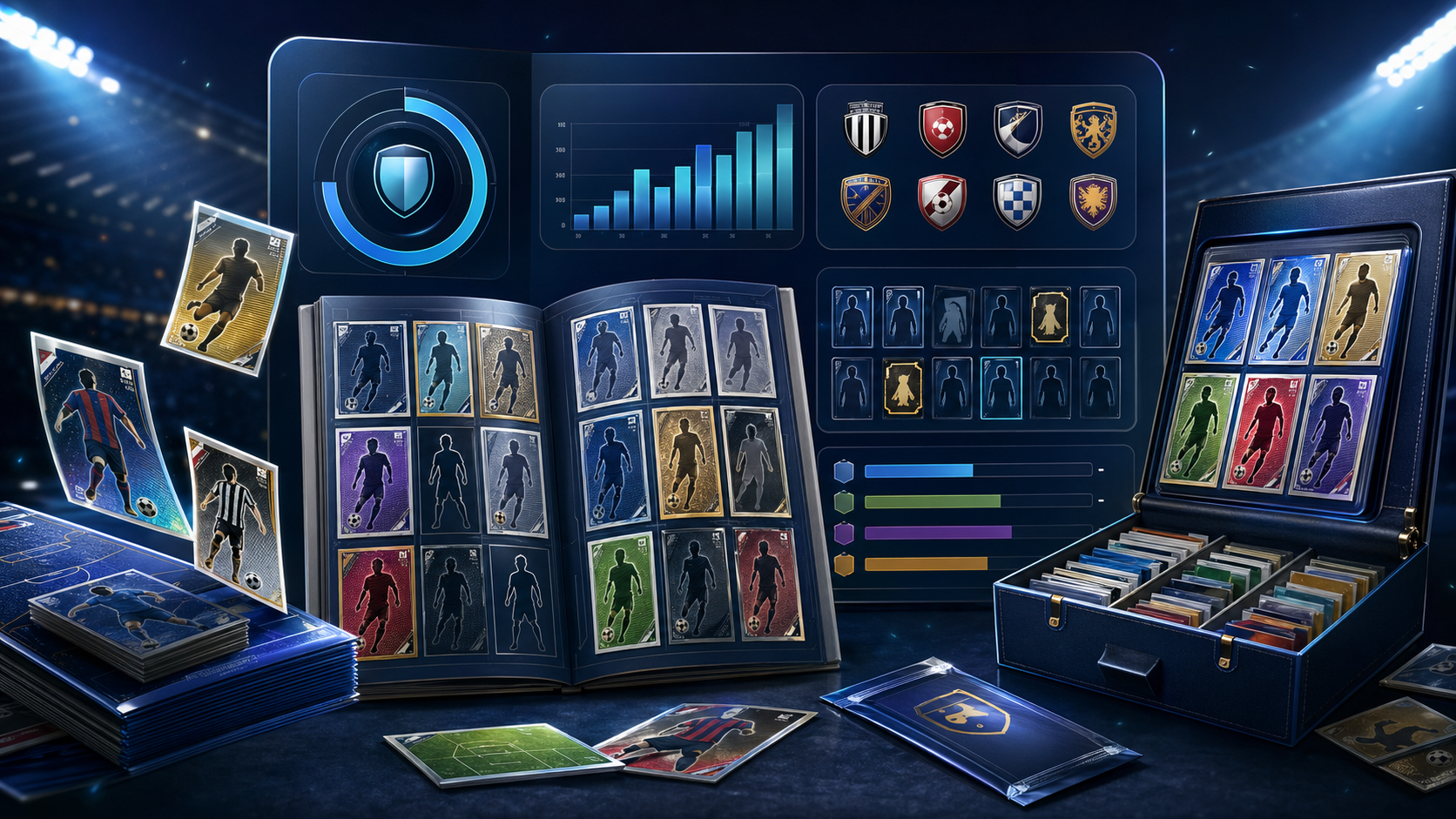








Collectors do not lose energy because collecting is hard. They lose energy because digital tools often make a simple hobby feel fragmented, repetitive, and strangely lonely. A collector opens one page to remember which album is active, another to check a team, another to guess what is still missing, and another to decide whether the next action should be a purchase, a trade, or just more waiting. That kind of experience creates mental clutter, and mental clutter is exactly what kills momentum. The new Collector Hub was built to remove that clutter. Instead of acting like a directory of disconnected features, it behaves more like the control room a real collector would design for themselves: one place to see album progress, one place to understand team by team status, one place to remember what is missing, and one place to decide what to do next without having to reconstruct the story from memory every single time. The page feels calmer because it is finally respecting how collectors actually think when they are trying to move forward.
What makes this release meaningful is not that we added more information to the screen. It is that we changed the sequence in which information appears and the confidence that sequence creates. When a collector lands in the hub now, the experience feels oriented. Albums do not look like raw records in a database; they feel like live projects with shape, context, and next steps. Team views are no longer side details hidden behind extra clicks; they are a fast way to focus, especially for people who collect with emotion and memory, not just inventory logic. If someone wants to see how far they have progressed with Argentina, Brazil, Mexico, or any other national team, the platform should help that thought immediately. The new flow respects that instinct. It lets the collector move from broad progress to specific gaps naturally, and that one design shift makes the product feel calmer, sharper, and much more serious from the first minute of use.
The most important emotional shift happens around missing stickers, because that is where a collector's attention usually becomes either productive or frustrating. In weak experiences, missing items are just a static list, something the user glances at before going back to improvising the next move. In a strong experience, missing items become the center of action. That is the direction we took. The new hub makes missing stickers feel visible, organized, and actionable, so the collector is not just staring at what is absent, but understanding what can be solved now. That difference matters more than it sounds. When a collector can see the gap clearly, they stop feeling behind and start feeling in motion. The journey changes from "I still need too much" to "I know exactly where I can make progress next." That is the kind of psychological clarity that turns a site into a habit instead of a one time browse, because it gives effort a sense of direction.
This is also why the Collector Hub was not built as an isolated page. It is meant to work in rhythm with the Trade Market and the Match Assistant, because collectors rarely move in only one mode. Some days they are organizing albums. Some days they are reacting to match day energy. Some days they are trying to move duplicates before enthusiasm disappears. The product has to support all of those states without forcing the user to restart the journey every time they switch intention. The hub now gives the experience that continuity. A collector can understand progress in one place, move into trade behavior with context, and come back without losing the thread. That is what mature product design looks like in practice. It does not just add pages; it creates continuity between pages so the user feels like the site understands their workflow instead of interrupting it whenever they want to do something practical.
From a launch and brand perspective, this is one of the most important pages we built because it changes the tone of the whole platform. It tells visitors that Stockeame is not guessing about collector behavior. It understands the routine, the friction, the excitement, and the small moments of satisfaction that make people stay engaged for weeks. The hub says, without saying it too loudly, that we are no longer presenting scattered tools and hoping users connect the dots on their own. We are doing the connecting for them. That is a much more trustworthy posture. It feels helpful rather than promotional, structured rather than noisy, and confident without being cold. When users feel that kind of clarity on the first interaction, the rest of the platform benefits immediately, because better organization is not just a convenience feature here. It is the foundation for stronger trading, deeper engagement, and a collector experience that finally feels under control from the inside out.